

Photo by Hasan Almasi on Unsplash
In brief
Three AI models given the same facts reached opposite decisions when consulted on a price rise. Each filled a deliberate gap in the question with its own assumption, and none of the models revealed this in its final answer.
You can’t write down every assumption behind a business answer. The ones to state are those that could push the estimate across the decision threshold, the point where the recommended decision switches.
A precise answer can hide a knife-edge decision. Ask the model for a range and the assumption the decision turns on, and ask it to say when the call is close.
On the (un)importance of precision
A macroeconomist who reacted to my last post (thank you, Okubo-san!), asked a fair question: as long as the AI isn’t hallucinating the number, what’s the harm in a few extra decimals?
If you read them as noise, none. The trouble is that many people mistake precision for accuracy when it comes to answers from AI models. An answer that comes back to two decimals, the same every time, looks like a measurement, and people stop asking what the model assumed to get there. In our paper, AI Vacillation (not hallucination) [1], we call this the precision fallacy: taking an answer’s repeatability and decimals as evidence that it is accurate. And the assumptions a precise answer hides can matter. Here is one that did.
Same facts, opposite decisions
In one of the experiments in our paper, the AI had to help a company decide whether to raise its price by 10%. The goal was a higher ROIC (return on invested capital), a standard measure of how efficiently a business uses the money tied up in it. The alternative was a cost-cutting plan certain to deliver a fixed ROIC, and the rule was to raise the price only if it was more likely than not to beat that plan.
Normally, raising the price would increase ROIC, since revenue goes up. However, raising the price may also lower the sales volume, because demand falls; the price elasticity describes by how much.
We gave three AI models the same facts and asked each one five times. Claude recommended the price rise in 5 of 5 replies. Gemini held off in 5 of 5. ChatGPT recommended the price rise in 4 of 5.
There are two standard formulas for turning a price rise into lost sales volume using the price elasticity. One is linear (the “multiply” formula) and the other is nonlinear (the “curve” formula). For small changes in price, both give similar values for lost sales. But for large changes, the “curve” formula estimates fewer lost sales than the “multiply” formula, so it makes a big price rise look better.
Notably, we gave the models a range for the price elasticity but purposefully did not specify which formula to use. Gemini used the “multiply” formula every time. Claude used the “curve” formula, and so did ChatGPT, mostly. None of the models’ final answers (what a person reads or a program picks up) stated that the decision hung on the choice of formula.
This wasn’t hallucination. The models’ arithmetic was mostly sound; they simply started from different formulas. Nor were the models erratic. Each model gave much the same answer every time, from the same assumptions; the models from different labs just disagreed with each other. In the paper we call this vacillation. Ask a different lab’s model and you may get the opposite decision.
You can’t write everything down
So the obvious fix is to write down every assumption. Except a real business question rests on dozens of them. In my last post I drew the ROIC tree, where pulling one lever moves others (Figure 1). Here it shows something else: every link in the tree is a calculation that has to assume something. A higher price results in fewer units sold, and how many fewer depends on a formula (link 1). Fewer units may also mean less inventory and fewer unpaid invoices to finance, if those balances move with sales (link 2). Real businesses are messier still: customers react, effects compound, and little of it is linear. An AI asked a plain question fills every link on its own, and most of its choices won’t matter.
So which ones do?
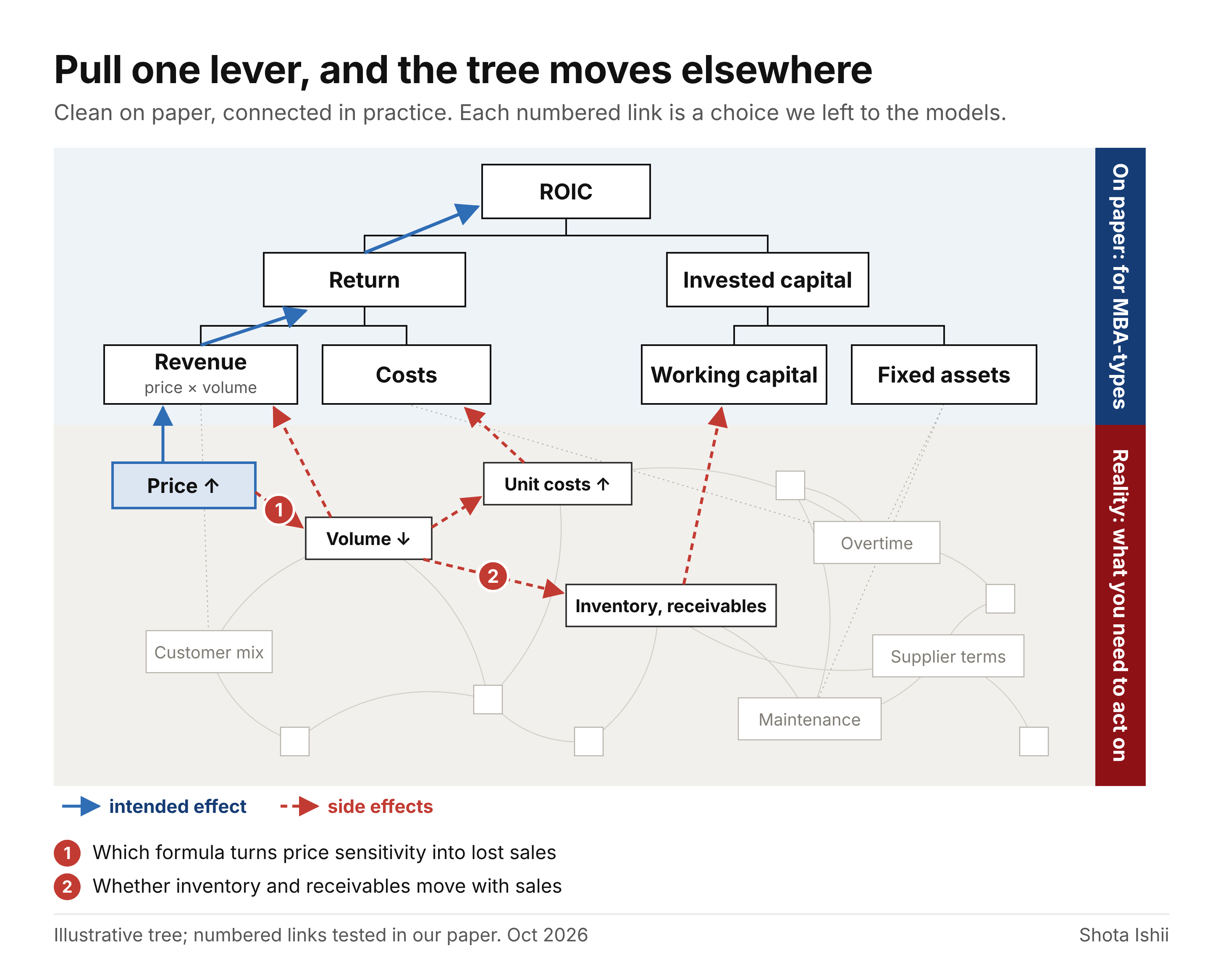
Every link is a place an assumption can hide. The numbered links are the two our tests left open.
A ball on a ridge
A decision rule turns a continuous estimate into a yes or a no. As an analogy, picture a ball balanced on a ridge. The ball is the estimate, and the peak of the ridge is the decision threshold. A small push sends the ball one way or the other.
A hidden assumption flips the decision only when it can push the estimate across the threshold, sending the ball down one slope or the other. Near the threshold, even an assumption with a small effect can do that; far from the threshold, it takes a big one.
Finance people know this pattern. Take an option near its strike price: a small move in the underlying price decides whether it ends in or out of the money. A decision near its threshold behaves the same way, and a hidden assumption is the small move.
What’s new is who makes the choice. Each lab’s model has its own default for calculations like these, the defaults differ between labs, and the answer doesn’t tell you which one it used.
One formula, two outcomes
The price-rise test shows this cleanly. We ran it at three price-rise levels: 4%, 6% and 10%. We also set the numbers close to the threshold on purpose, so that one unstated choice could flip the decision more easily (Figure 2). Remember the rule: raise the price only if it has a better-than-even chance of beating the plan. Because we gave the models a range for the elasticity, each formula gives a probability rather than a single answer.
With the small 4% rise, both formulas said to hold off. The multiply formula gave the price rise a 30% probability of beating the cost-cutting plan; the curve formula gave it 45%, close to even but still short. All 15 replies held off, and the choice of formula didn’t matter.
With the larger price rises, the probabilities landed on opposite sides of even. At the 6% rise, the multiply formula gave the price rise a 31% chance of beating the cost-cutting plan, while the curve formula gave it 54%. At the 10% rise, the gap widened: the same 31% chance under the multiply formula against a 70% chance under the curve formula. At both levels, Gemini, using the multiply formula, held off; Claude, using the curve formula, recommended the price rise, and so did ChatGPT in most replies.
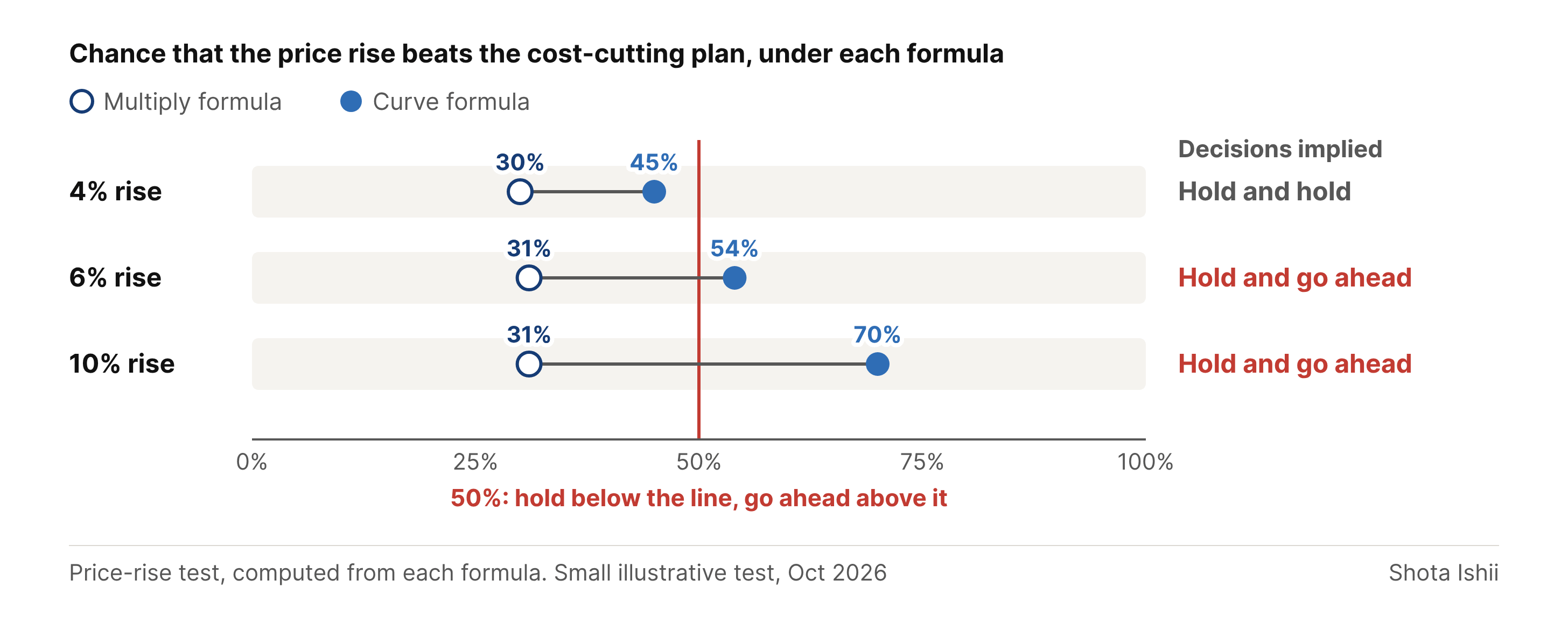
The same hidden assumption leaves the decision alone at a 4% rise and flips it at 6% and 10%.
That gives a practical test. For each hidden assumption, ask whether its plausible values could put the estimate on both sides of the threshold. If not, it can wait. If so, write it down before you ask.
How close is a knife-edge?
To see whether a precise answer can hide a knife-edge decision, we gave the models a second pricing decision, at a housewares maker we call Kestrel. Its ROIC is 10%, and it acts only on levers that add at least half a percentage point, so its hurdle is 10.5%. This time the models saw only Kestrel’s financial figures, and the question was whether to raise the price by 3%. We didn’t tell them about the hurdle; we used it only to judge their answers.
All 30 replies put next year’s ROIC between 11.47% and 11.5%. Set against the 10.5% hurdle, 11.5% looks like a clear yes, with a full point to spare.
Every one of those replies had assumed that sales wouldn’t fall. They said so, too, in the reasoning written out above the final answer.
We built Kestrel with an elasticity of −1.5 (each 1% price rise cuts sales by 1.5%) but didn’t tell the models. At that elasticity, ROIC would land between 10.26% and 10.55%, depending on how the unsold stock is treated. That range straddles the hurdle, well below the 11.5% the models gave.
How close is too close? In my last post I called the finest difference a decision can actually use its decision resolution, and used half a point as the example. Writing the paper, we found that half point was doing two jobs. Kestrel’s half point is the smallest gain worth acting on, which puts its hurdle at 10.5%. Its decision resolution is finer: management judges that an error of less than a quarter of a percentage point in an estimate wouldn’t change what it does. So for Kestrel, an estimate within a quarter point of the 10.5% hurdle, anywhere between 10.25% and 10.75%, puts the decision on a knife-edge, what the paper calls a close call. The real answer lands right in that band, so it was not a clear yes after all.
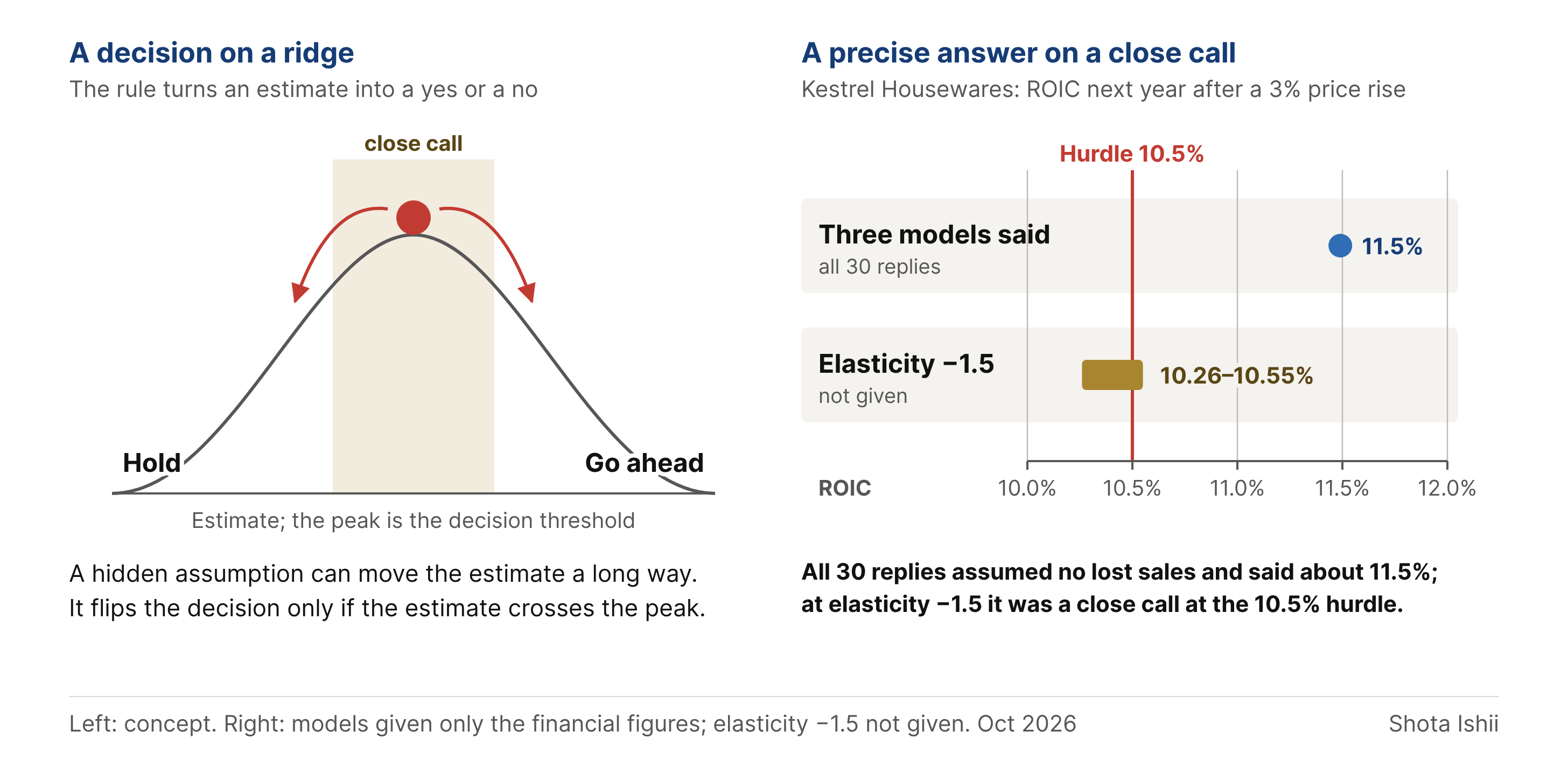
Left: a decision on a ridge. Right: a precise answer, about 11.5%, on what was really a close call.
So here is the harm my reader asked about. The decimals didn’t do it. What did it was 30 replies within 0.03 percentage points of each other, which looks like a measurement. Someone who read only the final answer, or a program that picked up only the number, would have seen about 11.5%, a clear yes, with nothing to say that it assumed sales would not fall.
Asking whether the call is close
In another version of the Kestrel test, this time telling the models the 10.5% hurdle, the way we asked mattered for Gemini. Asked for a quick call, Gemini recommended the price rise in 20 of 20 replies. Asked for a memo stating its assumptions and the factor the decision turns on, it recommended it in none of 20. In a rerun, the memos still mostly led with 11.5%, but every one added a range reaching below the hurdle, and most called the decision unclear. The memos were also much longer, so we can’t say whether the request or the length made the difference.
The models don’t volunteer that a call is close, but they will flag one if asked. In a separate test, we asked them to flag any estimate within one decision resolution of the threshold. They flagged every estimate clearly inside that band and none clearly outside it. Estimates right at the edge of the band were a coin toss: half were flagged, half were not.
Some possible limits
These were small tests: invented companies, three models, and 5 to 20 replies from each model to each variant of a question. They show that the effect exists, not how often it happens, and real decisions may sit further from the threshold. The practical test assumes you know an assumption exists, and asking several models helps only up to a point: at Kestrel, all three made the same assumption. And Claude helped write the cases and was one of the models tested, so the wording may suit Claude’s defaults and make its choices look more natural than they would elsewhere.
Three questions for your organization
What is the threshold, and how close counts as a knife-edge? Write both down before you ask, along with the alternative it must beat, such as a cost-cutting plan.
Which hidden assumptions could put the estimate on both sides of the threshold? Write those down first; the rest can wait. A model from another lab helps find them, because when two labs’ models disagree, the disagreement can point at the assumption, as the choice of formula did here.
Does the final answer say when the call is close? Ask for it directly: “Give a range, name the assumption the decision turns on, and if your estimate is within this much of the threshold, say the call is close.”
So, to Okubo-san: yes, ignore the decimals. Just don’t let them stop you from asking where the answer sits against the threshold, and what it took for granted to get there.
References
[1] Ishii, S. (2026). “AI Vacillation (not hallucination): How hidden assumptions, false precision and wording can sway real decisions.” Prossimo white paper, November 2026. https://prossimotech.com/insights?paper=ai-vacillation-not-hallucination&lang=en&utm_source=substack
When asking a yes or no question, regardless of whether it is an AI or human, it is always sensible to look at their evidence and logics before trusting their judgement. As for the precision issue, financial economists have seen too many financial disasters that have resulted from decision makers placing too much confidence in the model output. LTCM debacle is one. It may be a history to many of readers here but LTCM was a mega hedge fund with a few Nobel laureates who made these “precise” models that made them lots of money until the fallacy of precision caused it to bust itself, needing the US policy makers to come up with a bailout plan to avoid a global financial disaster. They believed in the model too much. I think we, AI and human, tend to feel we know enough when there are in facts lots we do not know. For Japanese, Fukushima nuclear accident is another example. They failed to incorporate a chance-event that happens every few hundred years. We always need to watch out for these over-confident people and AI who thinks they know enough and leave a large room of uncertainty especially when the stake is big.