

Photo: Patrick Hendry on Unsplash
In brief
The terms “ontology”, “semantic layer” and “context layer” overlap. I treat them as parts of a single knowledge layer. An item belongs in it only if someone can say where it came from, who answers for it and when it was last confirmed.
The evidence is encouraging: in one benchmark, modeling the knowledge over the same data took AI accuracy from 17% to 54%.
In my experience, the ontology is rarely what needs to be built first. The basics usually come first: knowing which table is current, which codes mean the same supplier and what “cost” means.
One knowledge layer
In the past year I have heard “ontology” used for a data model, a metrics dictionary and an entire AI platform, sometimes in the same meeting. Palantir uses the word for its whole operational platform, including the actions that change data. [1] To a knowledge engineer, an ontology is only the schema: what kinds of things exist and how they relate. Add “semantic layer”, [2] “context layer” [3] and, newest, “context graph”, [4] and a CFO who hears “we need an ontology” has every reason to ask which one, and how much of it.
Jessica Talisman argues that these terms should be kept apart, because each comes from a different discipline. [5] I agree that they name different parts. But an agent needs the parts to work as one layer, which I call the organization’s knowledge layer. It holds what the organization knows about its data, connected to that data and delivered to the people and agents who use it. Ananth Packkildurai makes a related case, that an ontology for agents is a system, not a single artifact. [6]
Three questions decide whether something belongs in it, whatever technology holds it. Where did it come from? Who answers for it? When was it last confirmed? The first and the last are its provenance, [7] and an agent needs it as much as a person does: it is how anyone can check an answer, or tell this year’s cost table from last year’s. Every item needs a source and a date; every kind of item, such as a definition, a code mapping or a rule, needs an owner. A supplier mapping kept in a spreadsheet by procurement passes. A graph that a model extracted from thousands of documents, with nobody answering for it, does not, at least not yet.
Does knowledge improve agents? The evidence
Let’s start with an example of what can go wrong. An agent is asked whether a 4% price increase keeps a product’s margin above target. It finds a cost table, does the arithmetic and answers “yes.” The answer is wrong, for three reasons. The table was last year’s, and nothing in the table said so. The largest supplier appeared under two codes, so the agent read only half of its costs. Finally, “cost” meant landed cost in procurement but standard cost in finance. The agent had all the data, but it lacked what the organization knows about its data.
Published studies point the same way. In a benchmark built on a standard insurance data model, GPT-4 answered 16.7% of business questions correctly when querying the database directly, and 54.2% when querying a knowledge graph built over the same data. [8] When dbt Labs, which sells semantic-layer software, reran the benchmark in 2026, the AI was right on every question its semantic layer could express. Plain database queries improved too, once the data was modeled. [9] The gain comes from modeling the knowledge, not from a particular tool.
The dbt study also compared how each approach fails. On questions outside its scope, the semantic layer declined with an error. Queries generated straight from the database sometimes returned plausible wrong numbers, with no sign that anything had failed. [9] An agent that acts on its own results needs that difference: it is how the agent knows when to stop and ask.
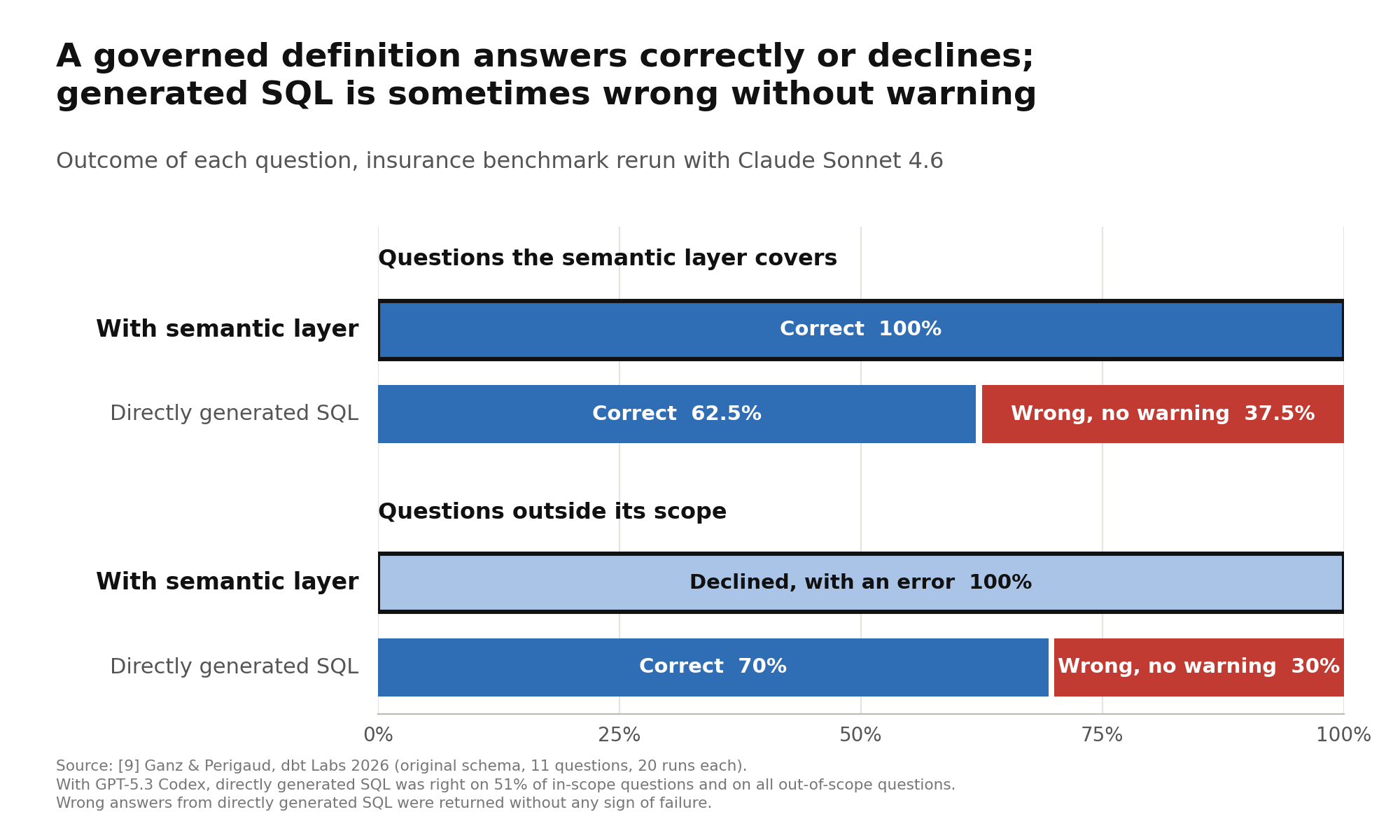
A governed definition answers correctly or declines. Generated SQL is sometimes wrong without warning.
Much of this evidence comes from analytics questions and from vendors, some of the tests are small, and stronger models narrow the gap every year. What lasts is consistency, a clear refusal outside scope, and sources anyone can check.
A map of the knowledge layer
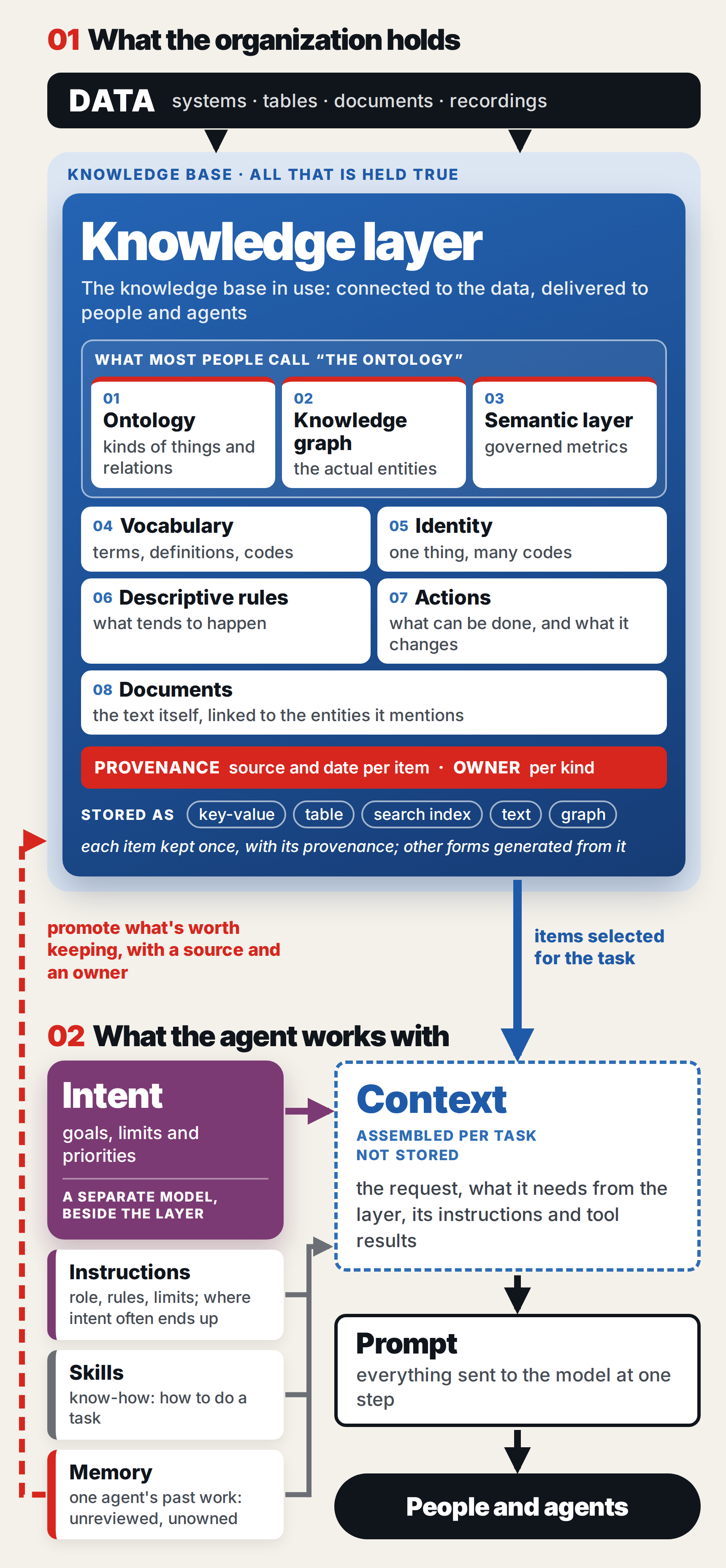
Top: what the organization holds. Bottom: what an agent works with when it runs.
In this map, a semantic layer and a knowledge graph are components inside the layer. What Atlan calls a context layer is close to the whole layer plus the machinery that assembles context for each task. A context graph of past decisions is a source the layer can learn from.
The map rests on four claims.
In my experience, the ontology is rarely the first thing an agent needs. Nothing in the pricing example failed for lack of a schema. The agent needed the current table, one identity for the supplier and one definition of cost.
A knowledge layer is not a graph database. The same knowledge can live in several forms: a key-value lookup, a relational table, a search index built on embeddings, a graph. Which one fits depends on the shape of the data, the questions asked of it, and how fast and cheap the answer needs to be. A supplier code mapping is a lookup; a quarterly margin is a database query; a contract clause is found by search; only questions that follow several relationships at once need a graph. I keep each item once, with its provenance, and generate the other forms from it, so an embedding is never the only copy of a fact.
Memory and context are not the layer. Context is rebuilt for each task, and an agent’s memory is usually unreviewed and unowned. Whatever is worth keeping should be promoted into the layer.
Knowledge is not intent. The layer can record that a pricing limit exists. How binding it is, and which goal comes first, belong to a model of intent, the subject of my previous series. [10]
Three questions for your organization
Which of your agents’ answers could be wrong without anyone noticing? Would the agent say “I don’t know,” or give a plausible number?
Where is the definition of your most-used metric written down, and who owns it? If two systems disagree, which one does the agent use?
Pick one number an agent gave you this week. Could anyone say where it came from, who answers for it and when it was last confirmed?
Some possible limits
The boundary I draw is a choice, not a standard, and the ideas behind it come from data governance: provenance, stewardship, domain ownership. I know of no study yet that measures the effect of provenance and ownership on agents directly. Building and maintaining knowledge also takes expert time, and for simple lookups, plain document search is often enough. [11]
The full white paper, with all sources and a method for building the knowledge layer one business decision at a time, is on the Prossimo site: Agents Need Knowledge (PDF). If your organization uses these words differently, I would like to hear how.
References
[1] Palantir. “Overview” (Ontology). Palantir Foundry documentation. https://www.palantir.com/docs/foundry/ontology/overview/
[2] Klahr, J., Bhatia, K., Chilukuri, Y. & El-Rayess, N. (2026). “Open Semantic Interchange (OSI) Updates: Specification Now Live, New Working Group Members and More.” Snowflake Blog, January 27, 2026. https://www.snowflake.com/en/blog/open-semantic-interchanges-specs-finalized/
[3] Atlan (2026). “What Is a Context Layer for AI Agents? A 2026 Enterprise Guide.” Updated September 21, 2026. https://atlan.com/know/context-layer-for-ai-agents/
[4] Gupta, J. & Garg, A. (2025). “AI’s trillion-dollar opportunity: Context graphs.” Foundation Capital, December 22, 2025. https://foundationcapital.com/ideas/context-graphs-ais-trillion-dollar-opportunity
[5] Talisman, J. (2026). “Ontologies, Context Graphs, and Semantic Layers: What AI Actually Needs in 2026.” Context & Chaos (Substack), January 22, 2026.

[6] Packkildurai, A. (2026). “What an Ontology for AI Agents Actually Needs.” Data Engineering Weekly, August 14, 2026.

[7] W3C (2013). “PROV-Overview: An Overview of the PROV Family of Documents.” W3C Working Group Note, April 30, 2013. https://www.w3.org/TR/prov-overview/
[8] Sequeda, J., Allemang, D. & Jacob, B. (2023). “A Benchmark to Understand the Role of Knowledge Graphs on Large Language Model’s Accuracy for Question Answering on Enterprise SQL Databases.” arXiv:2311.07509. https://arxiv.org/abs/2311.07509
[9] Ganz, J. & Perigaud, B. (2026). “Semantic Layer vs. Text-to-SQL: 2026 Benchmark Update.” dbt Developer Blog, April 7, 2026. https://docs.getdbt.com/blog/semantic-layer-vs-text-to-sql-2026
[10] Ishii, S. (2026). “Failure of Knowledge vs. Failure of Intent.” Substack, October 4, 2026. https://shotaishii.substack.com/p/failure-of-knowledge-vs-failure-of
[11] Xiang, Z., Wu, C., Zhang, Q. et al. (2025). “When to use Graphs in RAG: A Comprehensive Analysis for Graph Retrieval-Augmented Generation.” ICLR 2026. arXiv:2506.05690. https://arxiv.org/abs/2506.05690