

Photo: Ahmad Odeh on Unsplash
In brief
Much of our disappointment with AI comes from asking for more precision than we can use. We don’t need the fifth decimal when we can only control down to the second.
Size each question to its decision resolution, the coarsest of what you can act on, what you can measure, and what actually matters, and expect answers at that resolution.
Be precise about what you ask and how you want it answered, and have someone other than the AI grade the result.
For AI’s sake
What if we lowered our standards a bit? For AI’s sake.
The problem with our problem with AI is that we expect too much. My friend David put it well at a recent dinner: “We have all stopped being coders. We have all now become QA testers.” And I find QA tedious, if important: it’s wonderful that OpenAI’s model produced results on 372 open math problems... but now, mathematicians may spend almost as much time checking the proofs as they would have spent solving them in the first place. [1]
So here is a thought. Lower our standards on precision from AI, and raise them on the ask and on the checking results.
Precision you can’t use
There are concepts from control theory that basically say we don’t need to predict or measure down to the fifth decimal point if we can only act to the second. It doesn’t pay to compute what a 0.5-degree turn of the steering wheel does when the actual wheels only move the car in 2-degree increments. Engineers call this actuator resolution: a controller can only be as fine as the device that carries out its commands.
The other concept is the noise floor: below a certain size, a signal can’t be told apart from the noise around it, so measuring more finely tells us nothing new.
AI answers often look more precise than they are. In one study, when models were asked for ranges they were “95% sure” of, the correct answer landed inside the range only about a fifth of the time on financial questions. Asking for more or less confidence barely changed the ranges. [2] So an answer to the fifth decimal can easily sit below the noise floor.
With AI, it often feels like we are trying to parallel park in a tiny spot on a Paris street with gorilla-sized hands. So the key is to size each action to the coarsest of these limits: what your levers can actually do, what you can actually measure, and the smallest change that still matters to the organization. We call this decision resolution.
Precise about the ask, relaxed about the answer
The tremendous and ever-accelerating power of LLMs is breathtaking in its potential, and often disappointing in the business of getting real stuff done. “But what do you expect from just a next-token predictor?” is too reductionist and facile. LLMs, and the machinery built around them to make them work, can work wonders. We blame them for slop, when our own prompts are run-on and inchoate.
What we need is to be more precise in articulating what we want AI to do and how it should respond, and at the same time to accept less-than-perfect answers by design, because that is all the precision we can use.
Andrej Karpathy had a salient post on this earlier this month. He asks LLMs to explain things in ASD-STE100, the controlled English used in aircraft maintenance manuals, but often only “80% of the way” there, because the full standard is quite stringent. [3] Strict on the format, relaxed on the standard.
A real-world example: raising ROIC
Say a company wants to improve its ROIC, its return on invested capital. What does that even mean? The math is clear: we have a formula, the ROIC tree. I can reduce the invested capital, or increase the returns. Let’s try to increase the returns — that is, I need to make more money.
So in theory, if I increase revenue by ten dollars (say, by raising prices), ROIC should go up, provided everything else stays the same. Except everything else doesn’t stay the same. A thousand dependencies mean that in practice the price increase may have done something else, like drive volume down, leave unsold inventory sitting in the warehouse, or spread my fixed costs over fewer units.
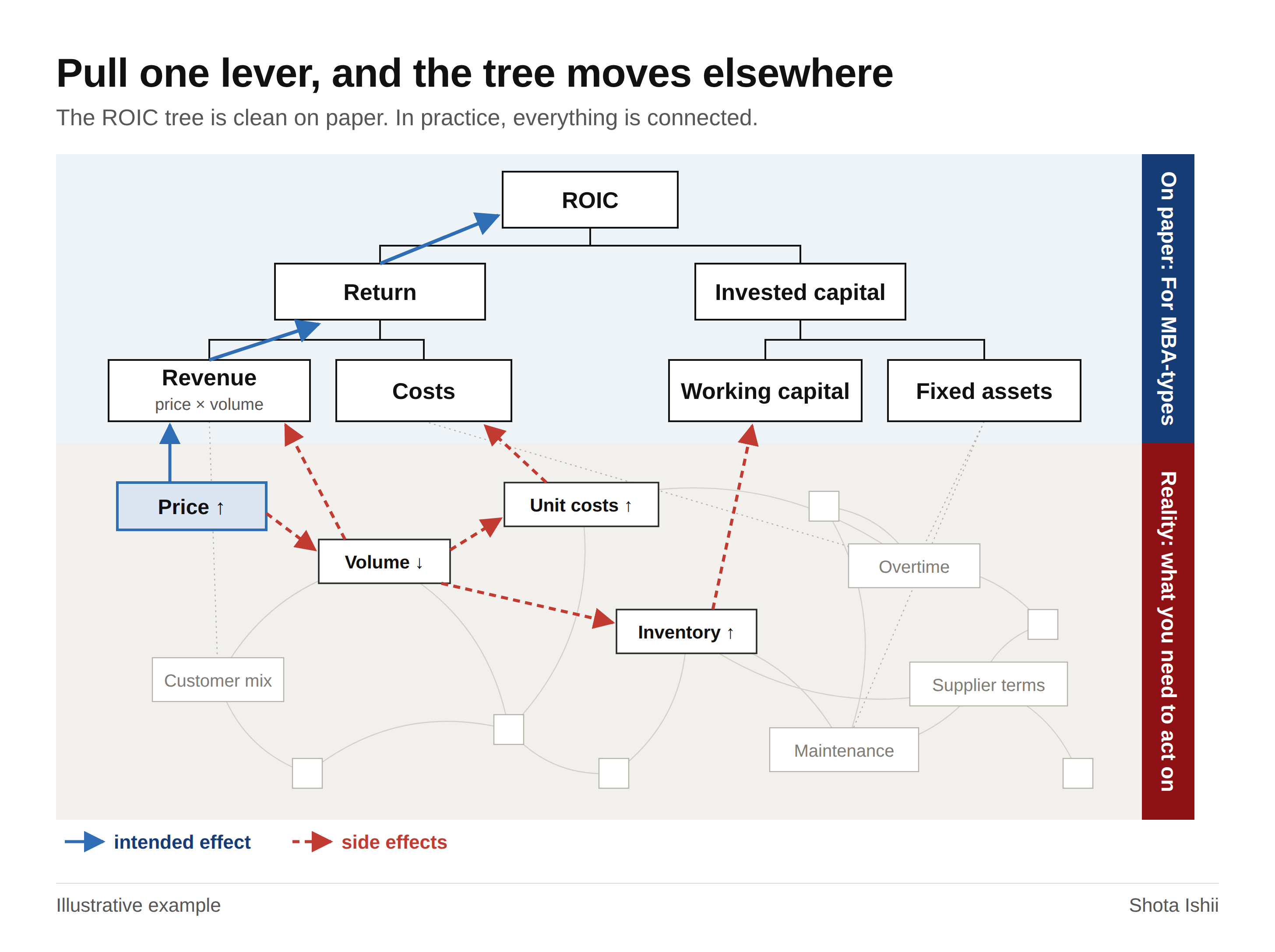
Pull one lever, and the tree moves elsewhere. Illustrative example.
So is it worth targeting a ten-dollar increase in sales? ROIC did go up, but by far less than the noise from everything else the price change set off. Maybe we need a floor: only consider levers that nudge ROIC by at least half a point, say from 10% to 10.5%. That’s the decision resolution for ROIC.
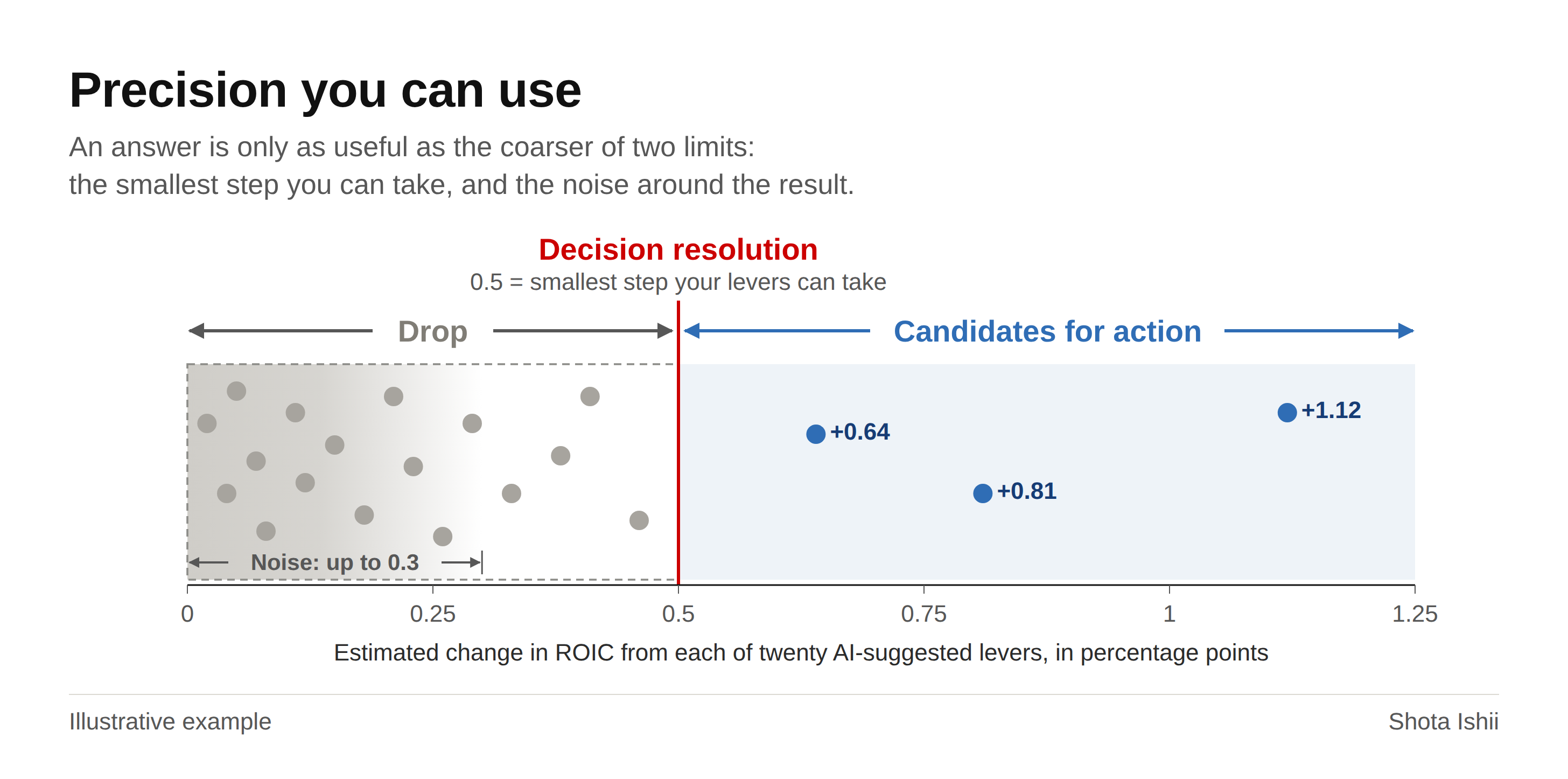
Decision resolution: only levers above the coarser of the two limits are worth checking. Illustrative example.
As an aside, where to actually set the floor for ROIC depends on the business. Over four decades, the median large US non-financial company earned about a 10% return on its capital, so a half-point change is about a twentieth of its returns. [4] The right floor depends on what the lever costs to pull, the risk it brings, and how much ROIC moves from year to year when nobody touches anything.
But how do we get the AI to keep track of the tangle of dependencies that move the target variable, then infer what impact pulling a particular lever has, while keeping track of everything else that happens at the same time... and keep the context it has to hold from exploding?
That calls for a certain parsimony with the design of the prompt and context, and a certain expectation that memory fades. When Chroma tested 18 models, their reliability dropped as the input grew longer, even on simple tasks. [5]
Part of the answer is to stop asking the AI to hold all of this in its head. The ROIC tree, with its definitions, should be written down outside the model, where it doesn’t fade as the conversation grows.
Grade the answer somewhere else
So if we ask AI for the twenty things we can pull to increase ROIC, we can’t expect them to be consistent and complete. We need a pragmatic heuristic to parse, filter and grade the recommendations. And ideally, this assessment is done independently of the AI that made the recommendation.
Finance has worked this way for a long time: the person who prepares a payment is not the one who approves it. For AI recommendations, a first version could be four checks:
Size. Does the lever clear the decision resolution, say half a point of ROIC? If not, drop it.
Side effects. Does the recommendation name its two or three biggest knock-on effects, and which way each one pushes? If not, it isn’t finished.
Basis. Does it say what data, assumptions and calculation choices it rests on, and how sure it is?
Grader. Someone other than the AI that made it does the grading, against the written ROIC tree. That can be a person, or a second model that sees only the tree and the recommendation. If it’s a model, read what it found, not just whether it approved.
Most of the twenty AI recommendations won’t survive the first check. The few that remain are the ones worth verifying and possibly acting on. The dull QA becomes something closer to working the problem collaboratively with AI. Keeping expectations realistic, ironically, makes the output of humans and AI more intelligent.
Three questions for your organization
Which numbers do you ask AI for at a precision you could never act on?
What is the smallest change in your key metric that would change a decision?
Who checks your AI’s recommendations, and did they write them?
Limits
Some things can’t be coarse: financial reporting, safety, legal commitments, and the definitions everything else rests on. The floor is a judgment call, and set too high, it throws away small levers that compound over time. A second model can share the first one’s blind spots, even one from another company, so an independent grader is not automatically an independent view. And this is a working practice, not a tested method; the four checks will change as we use them.
We can still park a car with gorilla hands. We just need a bigger space, and someone outside the car calling out the distance.
References
[1] OpenAI. “Sharing AI progress in mathematics.” October 6, 2026. https://openai.com/index/sharing-ai-progress-in-mathematics/ ; on the 372 result families and the race to check them: Schuler, M. “OpenAI’s 372 Math Results Leave Mathematicians Racing to Read the Proofs.” Implicator.ai, October 8, 2026. https://www.implicator.ai/openai-372-math-results-mathematicians-race-to-read/
[2] Bahaj, A., Rahimi, H., Chetouani, M. & Ghogho, M. “Gauging Overprecision in LLMs: An Empirical Study.” arXiv:2504.12098. https://arxiv.org/abs/2504.12098
[3] Karpathy, A. Post on X, October 2, 2026.


[4] Jiang, B. & Koller, T. “A long-term look at ROIC.” McKinsey Quarterly. https://www.mckinsey.com/capabilities/strategy-and-corporate-finance/our-insights/a-long-term-look-at-roic
[5] Hong, K., Troynikov, A. & Huber, J. “Context Rot: How Increasing Input Tokens Impacts LLM Performance.” Chroma, July 2025. https://trychroma.com/research/context-rot
Ishii-san, the theme of this essay seems interesting and important, and I like the title very much. But I cannot quite grasp what you want to say. Yes, AI sometimes gives out too many decimals in its answer but it is just a few extra numbers we can ignore. Yes, over precision is unnecessary, but as long as it is not hallucinating the number, what’s the harm?