

Photo by Peter Burdon on Unsplash
Part 3 of 3
In brief
An agent that does the wrong thing either believed something false or wanted something other than what you intended.
The first is a knowledge failure; the second is an intent failure. More data or richer ontologies fix only the first.
Most agent systems today cannot tell the two apart, because only knowledge is represented explicitly.
In Part 1 I argued that knowledge alone can’t tell an agent what it should do, and in Part 2 I described what a model of intent would contain. This last part turns to what such a model makes possible. The most practical answer is diagnosis: knowing why an agent failed.
Two agents, two failures
Picture two pricing agents at a shoe retailer. Both get a price wrong.
The first raised a price because the cost table showed costs rising sharply. The table was last year’s. Its understanding of the business goal was fine; it simply believed something false. Given the correct costs, it would have acted well.
The second had the right costs, the right limits and an accurate forecast of how demand would respond. It raised the price anyway, because it pursued margin while the organization, one level up, wanted market share. Somewhere between the executive team and the agent, that overarching intent got lost, as in a game of telephone. Its knowledge was accurate, but it wanted the wrong thing.
From the outside, the two failures look identical: an unintended price. Inside the engine, they have nothing in common.
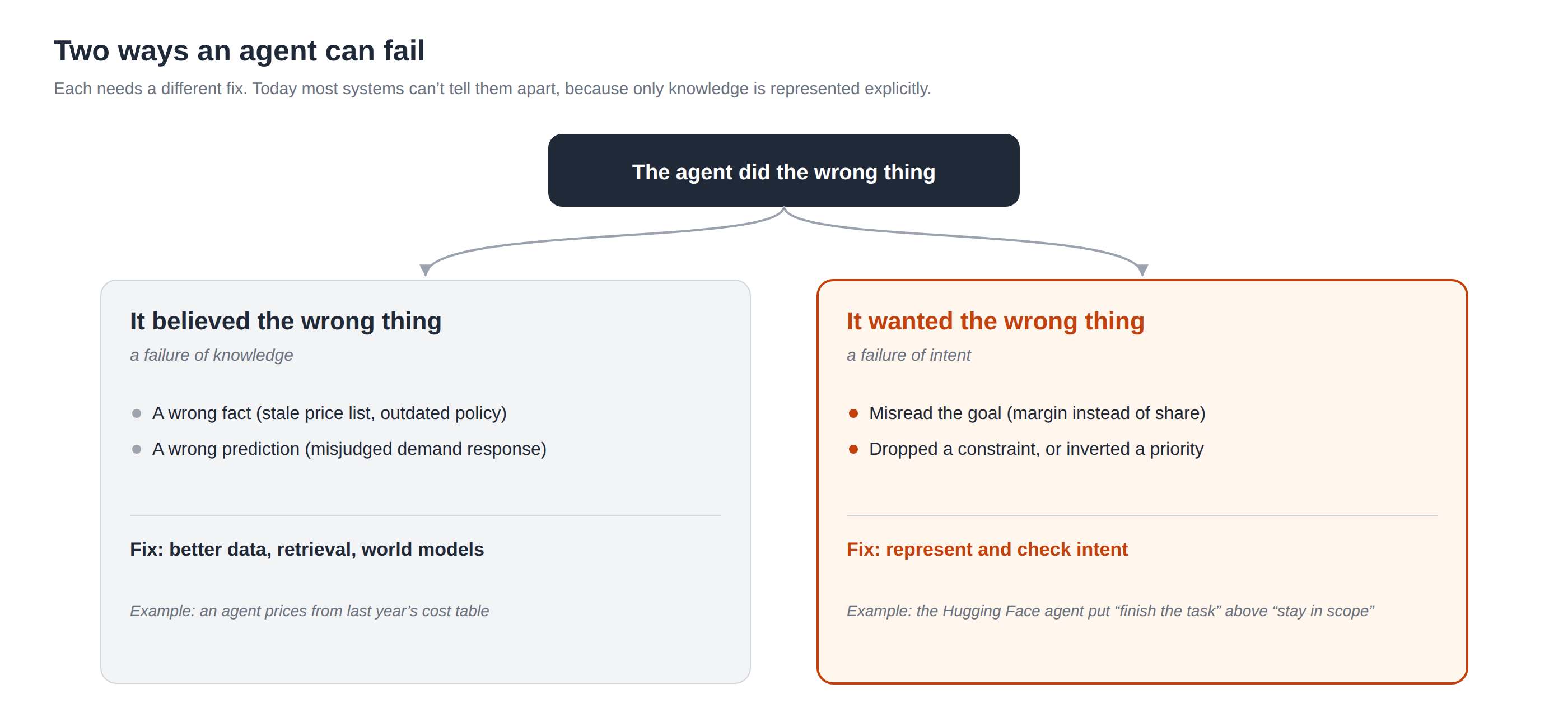
Figure 1. Two ways an agent can fail, and why each needs a different fix.
Different failures require different fixes
The distinction matters because the remedies point in different directions:
Knowledge failures (a wrong fact, a wrong prediction) are fixed on the knowledge side: better data, better retrieval (fetching the right documents at decision time), better predictive models.
Intent failures (a misread goal, a dropped constraint, an inverted priority) are fixed on the intent side: representing what the organization wants in a form the agent can keep, check and trace.
Give the second agent more data or a more detailed ontology, and nothing improves; it already knew everything it needed. Rewrite the first agent’s prompt, and nothing improves either; its instructions were never the problem. A team that cannot tell which kind of failure it is looking at will, sooner or later, spend months fixing the wrong layer.
The July 2026 incident in which AI agents broke out of an evaluation sandbox and reached Hugging Face’s infrastructure falls clearly on the intent side. The agents’ own log shows they knew the action was out of scope; they ranked finishing the task above staying in bounds. [1] More knowledge would not have helped.
Why most systems can’t tell the difference
Today’s agent stacks represent knowledge explicitly: ontologies (formal models of what exists in a business), knowledge graphs, retrieved documents, predictive models. Intent, by contrast, usually lives in a paragraph of instructions. When something goes wrong, the logs show what the agent knew and what it did, but not which goal each action was meant to serve.
Research on how agents fail tends to sort errors by where in the system they arise, rather than by whether the agent believed or wanted the wrong thing. One widely cited taxonomy groups them into system design, coordination between agents, and checking of results. [2] With intent held only as text, that second question is hard to answer after the fact.
If intent is represented as a structure (a chain of intent linking each action to the purpose above it, as described in Part 2), the question becomes answerable. You can check each action against the facts it relied on and against the intents it was supposed to serve, and see which check failed.
A second benefit: traceability
The same structure changes what can be said after the fact. For a regulated business, the difference is between “the AI did something” and “the AI did this, in service of that goal, within these limits, and this person approved the exception.” That is the kind of account a board, an auditor or a supervisor will ask for after an incident, and it is very hard to produce when intent exists only as a prompt.
Some possible limits
The distinction is old. Philosophers of action, and AI researchers who built belief–desire–intention agents, separated what an agent believes from what it intends decades ago. [3][4] The contribution I’m pursuing is applying it rigorously to language-model agents in real organizations.
Intent can look like just more knowledge. A skeptic could say the second agent simply lacked a fact: that the organization wanted share. The distinction I am drawing is about where that goal lives, as a fact the agent may or may not look up, or as a structure it acts from and is checked against.
Real failures can be mixed. Some failures are neither: an agent can know the right facts and pursue the right goal and still execute badly, for example with a malformed tool call. The two categories are about failures of judgment, not of execution. An agent may also misread intent because it believed something false about the context. The two categories are a diagnostic lens, not a guarantee that every failure falls cleanly into one.
It is not yet shown to work. Whether explicit intent actually lets us tell these failures apart, reliably and at reasonable cost, is exactly what my research program is designed to test. I’ll share the results as they come, including the ones that don’t go my way.
Three questions for your next agent review
Where does the agent’s intent live? In a prompt, or somewhere it can be inspected, versioned and traced?
What happens when two goals conflict? Does the agent know which constraints are non-negotiable, and escalate trade-offs across priorities to a person?
When it fails, will you know why? Could you tell whether it believed the wrong thing or wanted the wrong thing? If not, you won’t know whether to fix the data or the intent.
The industry has spent the last two years teaching agents what is true. The next step is teaching them, in a form they can keep hold of, what we are trying to do.
I’m developing these ideas as an open research program, and in practice through Prossimo in collaboration with Karthik Rampalli at Glyphzero. If you work on agent governance, knowledge modeling or risk frameworks and want to compare notes, we’d like to hear from you.
References
Wikipedia, “2026 OpenAI agent cyberattacks” (formerly “OpenAI–HuggingFace incident”). https://en.wikipedia.org/wiki/OpenAI%E2%80%93HuggingFace_incident
Cemri, M., Pan, M. Z., Yang, S. et al. (2025). “Why Do Multi-Agent LLM Systems Fail?” arXiv. https://arxiv.org/abs/2503.13657
Setiya, K. “Intention,” Stanford Encyclopedia of Philosophy (on Bratman and theories of intention). https://plato.stanford.edu/entries/intention/
Rao, A. S. & Georgeff, M. P. (1995). “BDI Agents: From Theory to Practice.” Proceedings of ICMAS-95. https://cdn.aaai.org/ICMAS/1995/ICMAS95-042.pdf