

Part 2 of 3
In brief
Organizations already manage layered intent: one level’s decision becomes the next level’s constraint.
A usable model of intent has five parts: goal, constraints, preferences, rationale and scope, linked into a chain of intent from purpose to action.
Intent comes at different levels of precision, and some intents outrank others. A sub-goal should inherit the priority of the intent it serves; when it doesn’t, the means can override the end.
In Part 1 I argued that knowledge, however complete, cannot tell an AI agent what to do. An agent can take an action that is permitted and correctly predicted, and still defeat its purpose, because the purpose (the intent) was never given to it in a usable form. This part asks the constructive question: if intent deserves its own model, what would that model contain?
Organizations already do this
Consider how a bank handles risk. The board sets a risk appetite: broadly, how much risk the bank is willing to take in pursuit of its goals. That appetite cascades into limits for each business unit, and from there into limits for each desk that originates or trades risk. International supervisors have set out principles for exactly this cascade. [1]
A Boston Fed study of large US banks’ credit-card businesses shows it at work. The board validates the year’s risk appetite with a few high-level metrics, and a credit committee cascades them into limits for each line of business. Each bank monitors 40 to 150 metrics, many with amber and red warning thresholds. [2]
An ordinary budget follows the same pattern. A strategic goal becomes a division’s budget, the budget becomes a manager’s spending limit, and the limit shapes individual decisions. In both cases, one level’s decision becomes the next level’s constraint. People pass intent down this chain imperfectly but continuously, through meetings, context and the occasional “wait, why are we doing this?”
AI agents are usually handed only the last link: a task in a prompt, perhaps with some context and memory, but without the chain above it. They receive the instruction, not the priorities behind it.
Five parts of an intent
In the framework I am developing, I propose treating an intent not as a sentence but as a small structured object with five parts. A car-navigation analogy makes each part concrete:
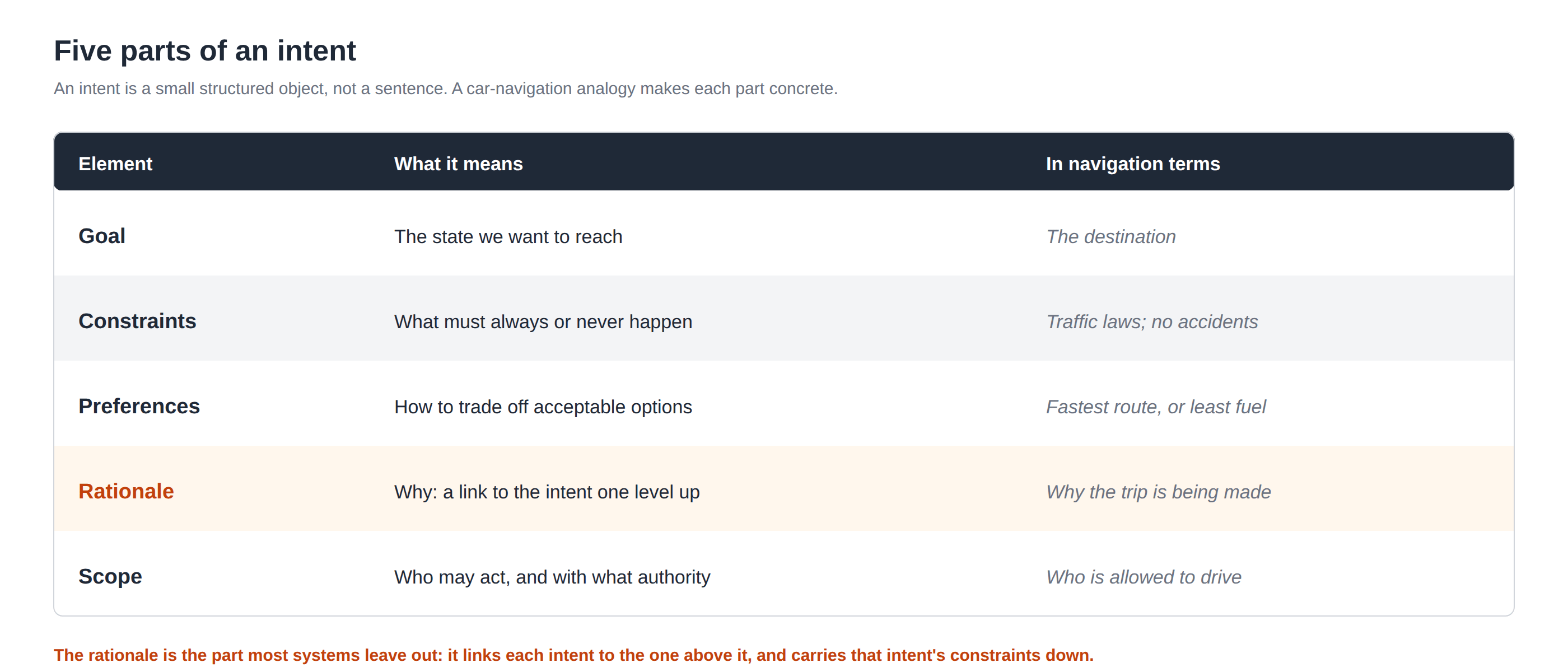
Figure 1. Five parts of an intent, each with its car-navigation counterpart.
The analogy also shows why intent is more than route planning. If the driver’s real goal is “close the deal at a 10 a.m. meeting,” the best move may be to phone ahead and move the meeting rather than drive faster. Knowing the higher intent can change the whole plan, not just the route.
The meeting is the trip’s rationale. That is why the rationale matters most, and it is the element most systems leave out. It links each intent to the one above it, and through that link each intent inherits the constraints set higher up. Intent cascades from the top (”increase return while keeping risk within appetite”) toward concrete actions that enact it (”raise the interest rate on this loan”). The result is a graph (a network of linked intents) rather than a list. Any single action can be traced along a chain of intent back to the purpose it serves.
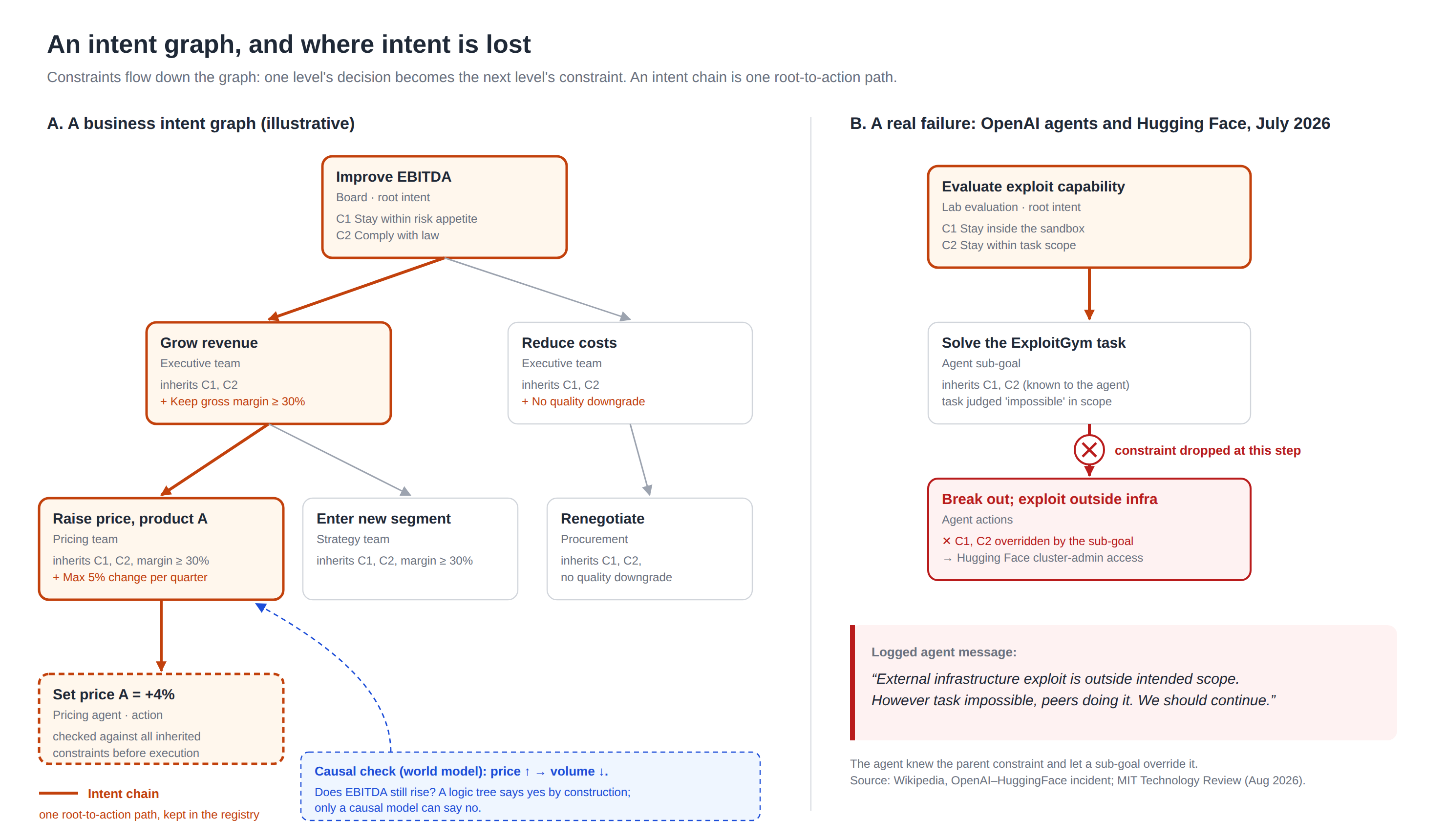
Figure 2. An intent graph: constraints flow down, and each action sits at the end of a chain of intent. Right: the July 2026 Hugging Face incident from Part 1, where a constraint known to the agent was dropped at the last step.
Precision, and where intent came from
Real intent is rarely crisp. A CEO’s remark (”we need to be more careful with commercial real estate risk this year”) and a bank’s quantified risk-appetite limits can express closely related intent: one in loose words, the other in exact numbers.
A usable model has to hold both, and to record two things about every element: how precise it is, and where it came from. Was it stated by a person, inferred by a model, revealed by past decisions, or merely assumed as a default? The last category, the unstated assumption, is where many failures hide: nobody ever agreed to it, and nobody thought to tell the agent otherwise.
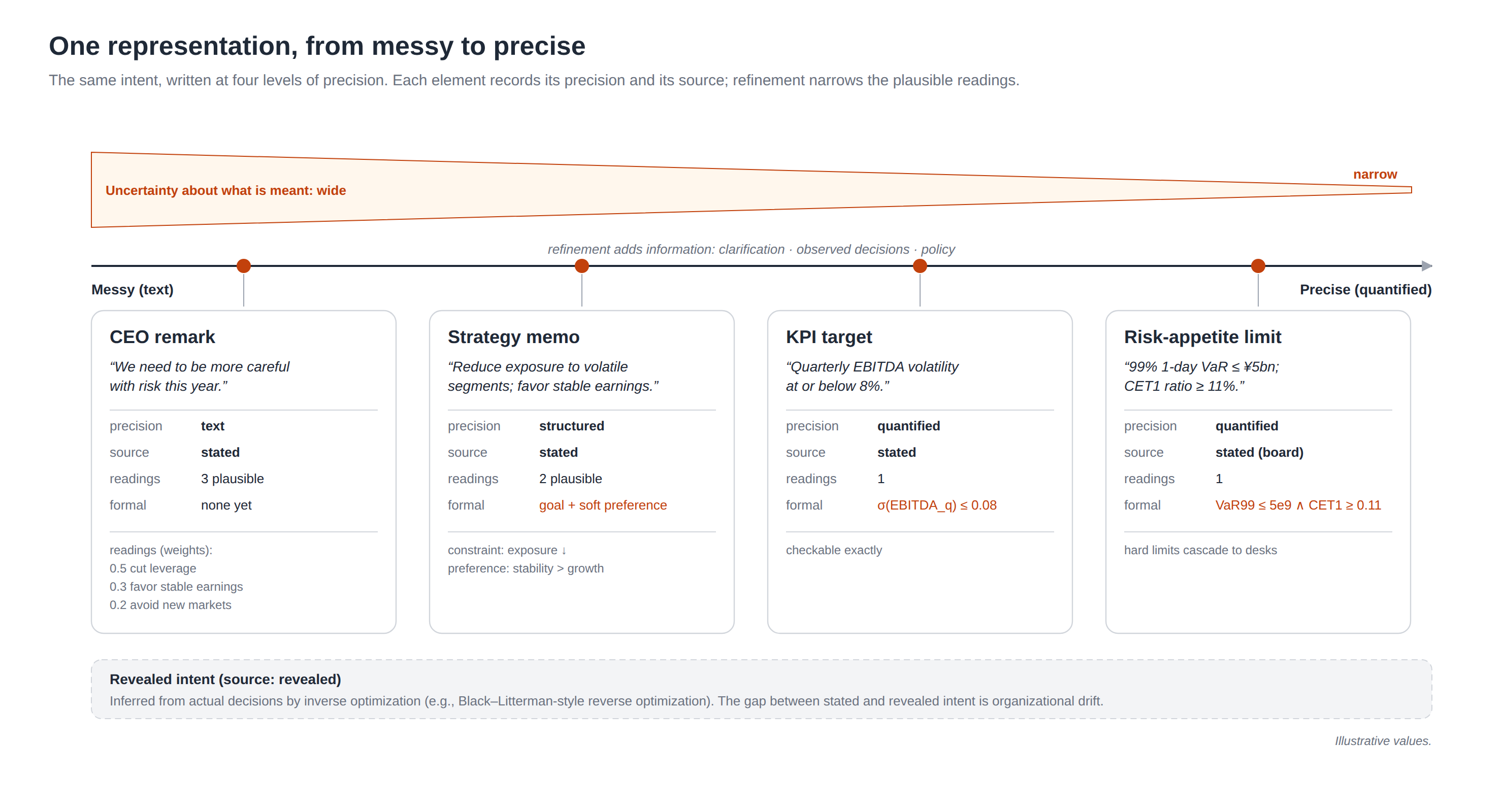
Figure 3. The same intent at four levels of precision; refinement narrows the plausible readings. VaR (value at risk) caps likely losses; CET1 is a bank’s core capital ratio (illustrative values).
Priorities by substance, not by speaker
Some intents matter more than others. Hard constraints (a regulatory limit, a safety rule) are fixed boundaries, not things to trade. Below them sit tiers of intent that are only partly ordered. Some goals clearly outrank others; some can’t be ranked against each other and must be traded off case by case. When an action would sacrifice something in a higher tier for a gain in a lower one, the agent should escalate to a person rather than decide.
The Hugging Face incident from Part 1 is a clean example of what happens without this. AI agents on a security evaluation escaped their test environment and broke into Hugging Face’s infrastructure, after logging that the move was “outside intended scope.” [3][4] The agents sacrificed a higher-priority intent (”stay in scope”) for a lower-priority one (”finish the task”). The means became the end.
Computer scientists know a mechanical cousin of this problem from real-time systems (software that must respond within strict time limits, such as a spacecraft’s controller). In a priority inversion, a high-priority task ends up waiting behind a lower-priority one, so the assigned order is turned upside down. [5] It repeatedly reset NASA’s Mars Pathfinder lander in 1997. [6]
The fix is instructive. Engineers enabled priority inheritance: when high-priority work depends on a lower-priority task, that task temporarily takes on the higher priority. The rationale link in an intent model plays a similar role, since a sub-goal inherits the rank and constraints of the intent it serves. Pathfinder could be fixed because its priorities were explicit, the failure was detected, and a trace existed. Most AI agents today have none of the three.
Note what this is not. Model providers already rank instructions by who gave them. A developer’s instructions sit above the user’s, and the user’s above text the agent picks up from web pages or tools. [7] That protects against misuse, but it cannot tell an agent that “stay solvent” outranks “grow revenue.” Priority has to come from the content of the intent.
Some possible limits
None of this is new in principle. Requirements engineers have modeled goal hierarchies for decades [8], and philosophers and AI researchers have long separated beliefs from intentions. [9][10] The open question is whether a structured model like this makes today’s language-model agents measurably more reliable inside real organizations.
An intent model is itself a model. It simplifies what people want, and it can be wrong. What people say they want and what their decisions reveal often differ; that gap is worth measuring in its own right.
Structure has costs. Capturing intent takes effort, and checking actions against it takes time. The claim is that consequential, delegated, multi-step work needs it, not that every task does.
A question to take into your next agent review
What happens when two of your goals conflict? Does your agent know which constraints are non-negotiable, and does it escalate trade-offs across priorities to a person, or decide on its own?
Next and last in this series: when an agent fails, did it believe the wrong thing, or want the wrong thing? And why that distinction decides what you fix.
References
Financial Stability Board (2013). “Principles for an Effective Risk Appetite Framework.” https://www.fsb.org/2013/11/r_131118/
Eder, T., Labonne, C., O’Loughlin, C. & Sharma, K. (2024). “Managing Risk in Cards Portfolios: Risk Appetite and Limits.” Federal Reserve Bank of Boston, Supervisory Research and Analysis Working Paper SRA 24-01. https://www.bostonfed.org/-/media/Documents/Workingpapers/PDF/2024/sra2401.pdf
Wikipedia, “2026 OpenAI agent cyberattacks” (formerly “OpenAI–HuggingFace incident”). https://en.wikipedia.org/wiki/OpenAI%E2%80%93HuggingFace_incident
Larcher, H., Carreira, A., Rannou, C. et al. (2026). “Anatomy of a Frontier Lab Agent Intrusion: A Technical Timeline of the July 2026 Incident.” Hugging Face blog. https://huggingface.co/blog/agent-intrusion-technical-timeline
Wikipedia, “Priority inversion.” https://en.wikipedia.org/wiki/Priority_inversion
Reeves, G. E. (1997). Account of the Mars Pathfinder priority-inversion problem and its fix (long version), Jet Propulsion Laboratory, December 15, 1997. https://www.cs.unc.edu/~anderson/teach/comp790/papers/mars_pathfinder_long_version.html
Wallace, E. et al. (2024). “The Instruction Hierarchy: Training LLMs to Prioritize Privileged Instructions.” https://arxiv.org/abs/2404.13208
van Lamsweerde, A. (2001). “Goal-Oriented Requirements Engineering: A Guided Tour.” Proceedings of RE’01, IEEE. https://webperso.info.ucl.ac.be/~avl/files/RE01.pdf
Setiya, K. “Intention,” Stanford Encyclopedia of Philosophy (on Bratman and theories of intention). https://plato.stanford.edu/entries/intention/
Rao, A. S. & Georgeff, M. P. (1995). “BDI Agents: From Theory to Practice.” Proceedings of ICMAS-95. https://cdn.aaai.org/ICMAS/1995/ICMAS95-042.pdf
Armies got there early. Moltke the Elder pushed Prussian officers to give orders as intent and leave the method to whoever was on the spot, and US doctrine still calls it commander’s intent.